


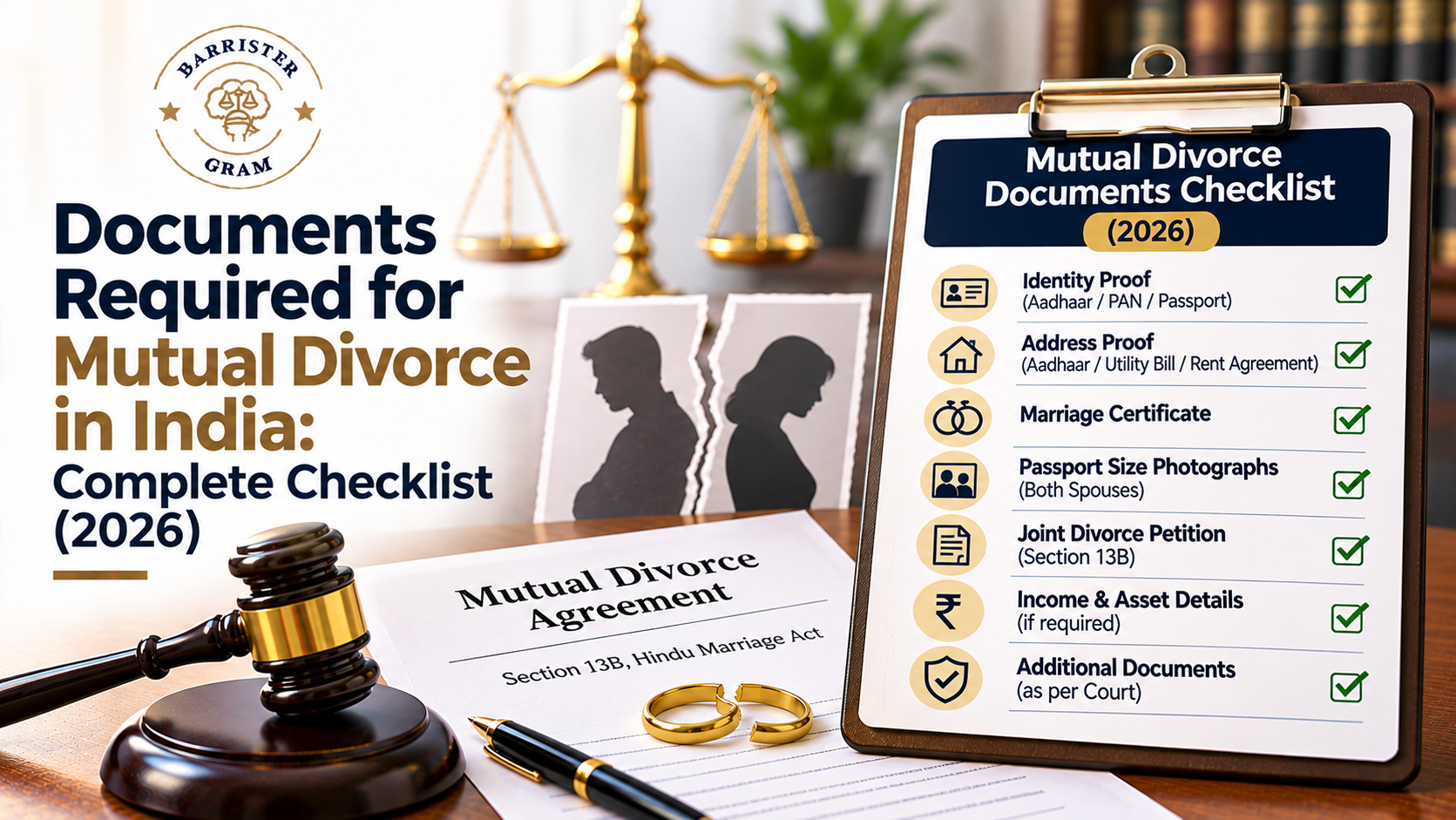
Documents Required for Mutual Divorce in India: Complete Checklist (2026)
For a mutual consent divorce under Section 13B, Hindu Marriage Act, 1955, you need a joint divorce petition,affidavits of both spouses, proof of marriage (marriage certificate or wedding photographs), address and identity proof, proof of living separately for at least one year, and a settlement agreement covering alimony, child custody and property. Both spouses must sign the petition and appear before the Family Court.
Key Takeaways
- A mutual consent divorce for Hindus, Buddhists, Jains and Sikhs is filed under Section 13B of the Hindu Marriage Act, 1955, by a joint petition signed by both spouses.
- Both spouses must have lived separately for at least one year before filing and must agree that they cannot live together.
- The core documents are the joint petition, affidavits of both spouses, proof of marriage, identity and address proof, proof of separate residence, and a written settlement on alimony, custody and property.
- A registered marriage certificate is helpful but not mandatory; wedding photographs, invitation cards and witness affidavits can also prove the marriage.
- The six-month waiting period between the first and second motions can be waived by the court in suitable cases (Amardeep Singh v. Harveen Kaur, 2017).
- Couples married under the Special Marriage Act, 1954 file under Section 28 of that Act, which has a similar process and similar document requirements.
Introduction
When both spouses agree to end a marriage, mutual consent divorce is the fastest and least contentious route available under Indian law. But even a friendly divorce can be delayed for months if the paperwork is incomplete or the settlement terms are unclear.
Family Courts check the documents carefully at the first motion, and gaps in proof of marriage, residence or settlement terms are the most common reasons for adjournments.
This guide lists every document needed for a mutual divorce in India, explains why each one matters, covers extra documents for couples with children, property or NRI spouses, and walks through the process from filing to decree.
What Is a Mutual Consent Divorce and Which Law Applies?
A mutual consent divorce is a divorce granted when both spouses jointly ask the court to dissolve the marriage, after living separately for a set period and agreeing on the terms.
What the law says
(a) The statute: Section 13B of the Hindu Marriage Act, 1955 allows both spouses to file a joint petition for divorce if they have lived separately for one year or more, cannot live together, and have mutually agreed to dissolve the marriage. Under Section 13B(2), the court hears the second motion not earlier than six months and not later than eighteen months after the petition is presented.
(b) What courts have held:
- In Amardeep Singh v. Harveen Kaur (2017), the Supreme Court held that the six-month waiting period is directory, not mandatory, and the Family Court can waive it in suitable cases.
- In Sureshta Devi v. Om Prakash (1991), the Court held that either spouse can withdraw consent at any time before the decree is passed.
- In Shilpa Sailesh v. Varun Sreenivasan (2023), a Constitution Bench held that the Supreme Court can dissolve a marriage under Article 142 of the Constitution in appropriate cases.
(c) Practical advice: Settle all terms, including alimony, custody and return of belongings, before filing. Disputes that surface after the first motion are the main reason mutual divorces fail.
Which law applies to you
| Couple | Law | Provision | Minimum separation before filing |
| Hindus, Buddhists, Jains, Sikhs | Hindu Marriage Act, 1955 | Section 13B | 1 year |
| Inter-faith or civil marriages | Special Marriage Act, 1954 | Section 28 | 1 year |
| Christians | Divorce Act, 1869 | Section 10A | 2 years |
| Parsis | Parsi Marriage and Divorce Act, 1936 | Section 32B | 1 year |
| Muslims | Muslim personal law | Mubarat (mutual divorce), usually outside court | Not applicable |
Complete Checklist: Documents Required for Mutual Divorce
These documents are needed in almost every mutual divorce petition. Family Courts may ask for additional local formats.
| No. | Document | From whom | What it proves |
| 1 | Joint petition for divorce by mutual consent | Both spouses, signed | The application itself |
| 2 | Affidavit of each spouse (first motion) | Each spouse, attested | Facts of marriage, separation and free consent |
| 3 | Marriage certificate, if registered | Either spouse | Proof of marriage |
| 4 | Wedding photographs and invitation card | Either spouse | Proof of marriage, especially if not registered |
| 5 | Identity proof (Aadhaar, passport, voter ID, PAN) | Both spouses | Identity |
| 6 | Address proof of each spouse | Both spouses | Current residence and court’s jurisdiction |
| 7 | Proof of living separately for one year or more | Both spouses | Statutory requirement under Section 13B(1) |
| 8 | Settlement agreement or memorandum of understanding | Both spouses, signed | Agreed terms on alimony, custody, property and belongings |
| 9 | Details of children, with birth certificates | Both spouses | Custody and maintenance terms |
| 10 | Income proof (salary slips, income tax returns, bank statements) | Both spouses | Basis for alimony and maintenance |
| 11 | Details of assets and liabilities | Both spouses | Fair settlement; courts may ask for a disclosure affidavit |
| 12 | Passport-size photographs | Both spouses | Court records |
| 13 | Vakalatnama | Each spouse’s advocate | Authority to appear |
| 14 | Proof of payment of alimony (demand drafts, bank transfers) | Paying spouse | Compliance with settlement, usually at second motion |
| 15 | Application to waive the six-month period, if sought | Both spouses | Grounds under Amardeep Singh (2017) |
| 16 | Affidavits for second motion | Both spouses | Continued consent |
Notes on the Key Documents
Joint petition
The petition must state the date and place of marriage, the parties’ details, the date from which they have lived separately, that they cannot live together, and that they have mutually agreed to dissolve the marriage. It should also record that the consent is free and not obtained by force, fraud or undue influence, as Section 23 of the Hindu Marriage Act requires the court to be satisfied of this.
Proof of marriage
A registered marriage certificate is the simplest proof, but registration is not compulsory for filing a divorce. If the marriage was not registered, courts commonly accept:
- Wedding photographs showing both spouses and the ceremony
- The wedding invitation card
- Affidavits of persons who attended the wedding
- Documents that show the couple as spouses, such as passports or joint bank accounts
Proof of living separately
“Living separately” means not living as husband and wife, even if under the same roof in some cases. Useful proof includes:
- Separate rental agreements or address proofs
- Utility bills or bank statements showing different addresses
- Correspondence showing the separation date
- A clear statement in both affidavits giving the same date of separation
Settlement agreement
The settlement agreement is the heart of a mutual divorce. It should cover:
- Permanent alimony: a one-time amount or instalments, and the payment schedule
- Child custody and visitation: who has custody, visiting rights and holiday arrangements
- Child maintenance and education expenses
- Stridhan and personal belongings: return of jewellery, gifts and articles
- Property: transfer or division of jointly owned property, and loans
- Withdrawal of other cases: maintenance, domestic violence, Section 85 BNS (earlier Section 498A IPC) or other proceedings, as agreed and as permitted by law
- No further claims: a clause that neither party will claim anything further
Income and asset disclosure
Courts deciding maintenance often require both parties to file an affidavit of assets and liabilities, following the format set by the Supreme Court in Rajnesh v. Neha (2020). Even in a mutual divorce, the Family Court may ask for income details to ensure the alimony is fair.
Additional Documents in Special Situations
If you have children
- Birth certificates of the children
- School details and fee receipts
- Detailed custody, visitation and maintenance terms in the settlement
- The court may speak to the children if they are old enough, as their welfare is the paramount consideration
If property or joint loans are involved
- Property documents (sale deed, allotment letter)
- Loan statements and the agreed arrangement for repayment
- Draft transfer or relinquishment deeds, if property is being transferred
If one spouse lives abroad (NRI)
- A power of attorney for a relative to handle filing steps, where the court allows
- Passport and visa copies
- An application for appearance by video conferencing, which many Family Courts allow in suitable cases
- Affidavits attested before an Indian embassy or consulate, or notarised and apostilled abroad, as the court requires
If you want to waive the six-month waiting period
In Amardeep Singh v. Harveen Kaur (2017), the Supreme Court said the court may waive the period if:
- The statutory one-year separation, plus the six-month period, has already passed, counting from the separation
- All efforts at mediation and reconciliation have failed
- The parties have genuinely settled all their differences, including alimony and custody
- The waiting period would only prolong their agony
An application to waive the period should be filed with supporting facts, usually at or after the first motion.
Step-by-Step Process for Mutual Divorce
The process has two motions, with the documents above filed at the first motion and confirmations at the second.
- Agree on all terms and sign the settlement agreement.
- Prepare the joint petition and affidavits with your advocates.
- File the petition in the Family Court with jurisdiction. Under Section 19 of the Hindu Marriage Act, this is the court where the marriage was solemnised, where the respondent resides, where the parties last lived together, or, if the wife is the petitioner, where she resides.
- First motion: both spouses appear in person, confirm consent, and the court records their statements. The court may refer the parties to mediation or counselling.
- Cooling-off period: six months from the filing of the petition, unless waived.
- Second motion: filed after six months and within eighteen months of the petition. Both spouses appear again and confirm continued consent.
- Compliance with settlement: alimony payments and other terms are usually completed or confirmed by the second motion.
- Decree of divorce: the court passes the decree once satisfied.
- Obtain a certified copy of the decree for future use, such as updating records or remarriage.
Costs
- Court fee on the petition, as prescribed by your state (usually a small fixed amount)
- Advocate’s fees for each spouse
- Notarisation and stamp paper for affidavits and the settlement agreement
- Mediation, which is usually free at court-annexed centres
Worked Example: A Complete Mutual Divorce File
This example shows a couple’s document file at the first motion.
Ankit and Shreya Verma married in Jaipur on 10 February 2021 and have one son, aged 4. They have lived separately since 1 March 2025, Ankit in Jaipur and Shreya with her parents in Delhi.
| Document | What they have |
| Joint petition | Signed by both, filed in the Family Court, Jaipur (where the marriage took place) |
| Affidavits | Both state separation since 1 March 2025 and free consent |
| Proof of marriage | Registered marriage certificate, wedding photographs |
| Identity and address proof | Aadhaar of both; Ankit’s Jaipur rental agreement; Shreya’s Delhi address proof |
| Proof of separation | Ankit’s rental agreement from March 2025; Shreya’s bank statements showing her Delhi address |
| Settlement agreement | Permanent alimony of ₹12 lakh in two instalments; Shreya has custody; Ankit has weekend visitation; Ankit pays school fees; jewellery returned |
| Child’s documents | Birth certificate and school fee receipts |
| Income proof | Both spouses’ income tax returns and salary slips |
| Waiver application | Filed after the first motion, as separation exceeds 18 months and mediation failed |
The first motion is recorded in September 2026. As separation has already exceeded 18 months and the terms are fully settled, the court considers their waiver application, subject to its discretion under Amardeep Singh.
Common Mistakes With Mutual Divorce Documents
- Different separation dates in the two affidavits.
- Vague settlement terms, such as “alimony to be decided later”.
- No proof of marriage when the marriage was not registered.
- Leaving out child custody and visitation details.
- Not disclosing income or assets, leading to objections or later disputes.
- Paying alimony in cash without receipts.
- Filing in a court without jurisdiction under Section 19.
- Missing the second motion within 18 months of filing.
Key Court Rulings on Mutual Divorce
| Case | Court and year | Key holding (one line) |
| Sureshta Devi v. Om Prakash, (1991) 2 SCC 25 | Supreme Court, 1991 | Either spouse can withdraw consent before the decree is passed. |
| Amardeep Singh v. Harveen Kaur, (2017) 8 SCC 746 | Supreme Court, 2017 | The six-month waiting period is directory and can be waived in suitable cases. |
| Rajnesh v. Neha, (2021) 2 SCC 324 | Supreme Court, 2020 | Parties in maintenance proceedings must file affidavits disclosing assets and liabilities. |
| Shilpa Sailesh v. Varun Sreenivasan, 2023 | Supreme Court, 2023 | The Supreme Court can dissolve a marriage under Article 142 in appropriate cases. |
FAQs
1. What documents are required for a mutual divorce in India?
You need a joint petition, affidavits of both spouses, proof of marriage (marriage certificate or wedding photographs and invitation), identity and address proof, proof of living separately for at least one year, a signed settlement agreement on alimony, custody and property, income proof, passport photographs and vakalatnamas.
2. Is a marriage certificate mandatory for mutual divorce?
No. A registered marriage certificate is the easiest proof, but registration is not compulsory to file for divorce. Wedding photographs, the invitation card, affidavits of persons who attended the wedding and documents showing the couple as spouses are commonly accepted.
3. How do we prove that we have lived separately for one year?
Through separate rental agreements, address proofs, utility bills, bank statements showing different addresses, and consistent statements in both spouses’ affidavits about the date of separation. Both affidavits must give the same separation date.
4. What should a mutual divorce settlement agreement include?
It should cover permanent alimony and the payment schedule, child custody, visitation and maintenance, return of stridhan and belongings, division or transfer of property and loans, withdrawal of other cases as agreed, and a clause that neither party will make further claims.
5. Can the six-month waiting period in mutual divorce be waived?
Yes. In Amardeep Singh v. Harveen Kaur (2017), the Supreme Court held that the period is directory. The Family Court may waive it if the one-year separation and six-month period have passed counting from separation, reconciliation efforts have failed, and all disputes are settled.
6. Do both spouses need to be present for a mutual divorce?
Generally yes, at both the first and second motions, because the court must record their consent. Many Family Courts allow appearance by video conferencing in suitable cases, especially when one spouse lives abroad.
7. Can one spouse withdraw consent after filing for mutual divorce?
Yes. In Sureshta Devi v. Om Prakash (1991), the Supreme Court held that either spouse can withdraw consent at any time before the decree is passed. If consent is withdrawn, the court cannot grant a mutual consent divorce.
8. Where should a mutual divorce petition be filed?
Under Section 19 of the Hindu Marriage Act, in the Family Court where the marriage was solemnised, where the respondent resides, where the parties last lived together, or where the wife resides if she is the petitioner. In a joint petition, couples usually choose a convenient court among these.
9. What documents are needed if one spouse is an NRI?
In addition to the standard documents, passport and visa copies, an application for appearance by video conferencing, and affidavits attested before an Indian embassy or consulate or notarised and apostilled abroad, as the court requires. A power of attorney may help with filing steps.
10. Is the documentation different for a Special Marriage Act divorce?
The documents are largely the same. Couples married under the Special Marriage Act, 1954 file a joint petition under Section 28, with proof of marriage (the marriage certificate under that Act), proof of one year’s separation and a settlement agreement. The six-month waiting period also applies.
Conclusion
A mutual divorce moves smoothly when the paperwork is complete and the terms are settled before filing. Prepare a joint petition and consistent affidavits, prove the marriage and the one-year separation, and put every term on alimony, custody and property in a clear, signed settlement agreement. File in the correct Family Court, attend both motions, and ask for the six-month period to be waived if you qualify. For advice on your specific situation, consult a qualified advocate.


About Post Author


