


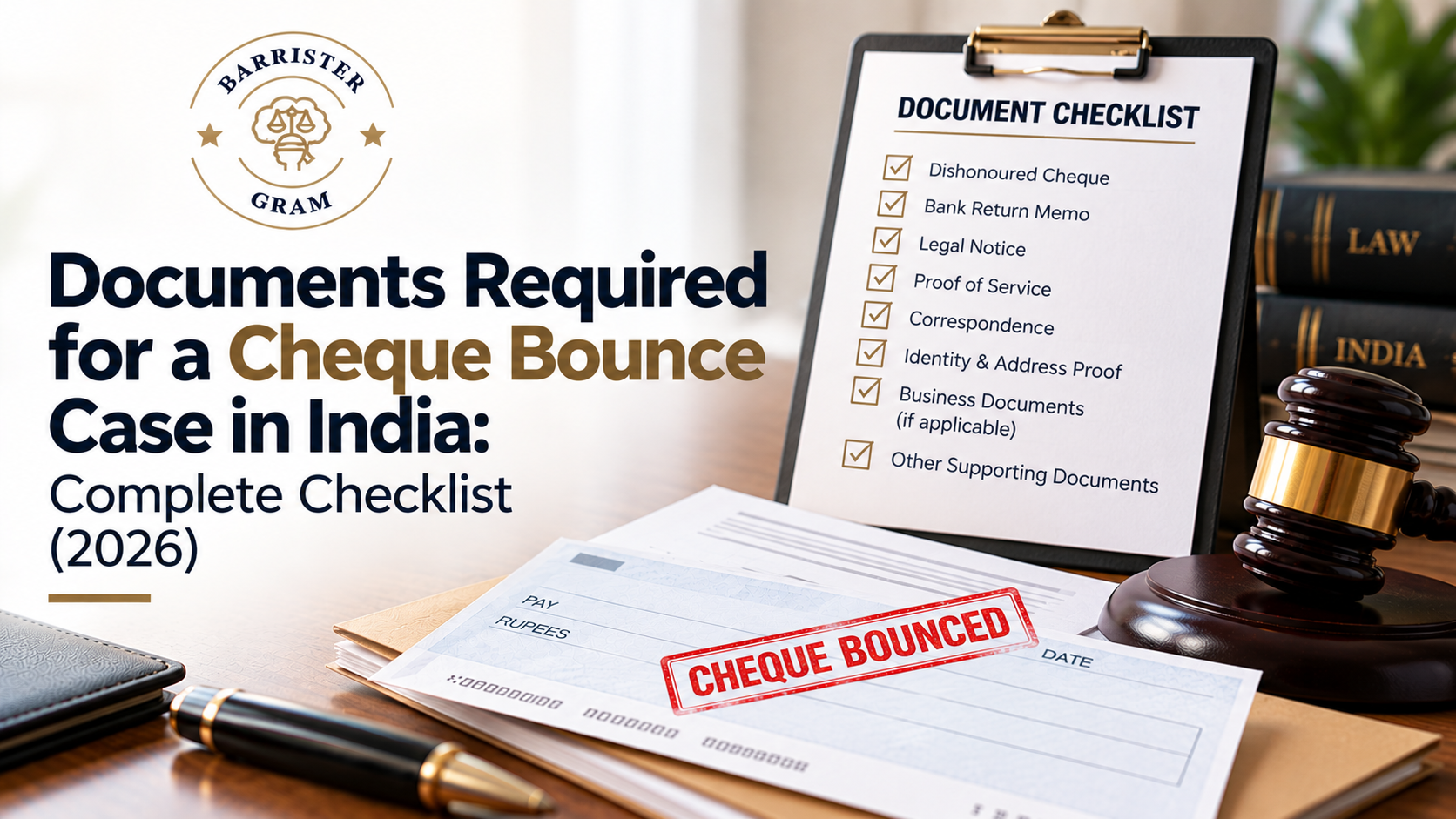
Documents Required for a Cheque Bounce Case in India: Complete Checklist (2026)
To file a cheque bounce case under Section 138, Negotiable Instruments Act, 188, you need the original cheque, the bank’s return memo, a copy of the legal notice, proof of sending and delivery, proof of the debt, a complaint with an affidavit, and a vakalatnama if an advocate appears. A company also needs a board resolution authorising the person filing.
Key Takeaways
- The two most important documents in a cheque bounce case are the original dishonoured cheque and the original cheque return memo issued by the bank.
- Under Section 146 of the Negotiable Instruments Act, 1881, the bank’s return memo is presumed to prove that the cheque was dishonoured, so the bank official usually need not appear as a witness.
- A copy of the legal notice, along with postal receipts and the tracking report or acknowledgement card, is required to prove that the notice was sent within 30 days and received by the drawer.
- Under Section 145 of the NI Act, the complainant’s evidence can be given on affidavit, which must be filed with or soon after the complaint.
- WhatsApp messages, emails and bank statements in electronic form need a certificate under Section 63 of the Bharatiya Sakshya Adhiniyam, 2023 (earlier Section 65B, Indian Evidence Act) to be relied on as evidence.
- After the Supreme Court’s 2025 judgment in Sanjabij Tari v. Kishore S. Borcar, complaints are to include a standard synopsis setting out the parties, cheque details, dishonour, notice and cause of action.
Introduction
Most cheque bounce cases are won or lost on paper. The law presumes a lot in the complainant’s favour, but only if the right documents prove that each legal step was taken on time.
A missing return memo, a lost acknowledgement card or an unsigned affidavit can delay the case for months or weaken it entirely. On the other side, an accused person with the right documents can rebut the presumption of debt.
This guide lists every document needed for a cheque bounce case, explains why each one matters, and covers the extra documents needed by companies, by people filing through a representative, and by the accused.
Why Do Documents Matter So Much in a Cheque Bounce Case?
A Section 138 case is proved largely through documents, because each ingredient of the offence, from issue of the cheque to non-payment after notice, must be shown with paper or electronic records.
What the law says
(a) The statute: Section 138 requires proof that (1) the cheque was drawn for a debt or liability, (2) it was presented within validity, (3) it was dishonoured, (4) a notice was sent within 30 days, and (5) the drawer did not pay within 15 days of receipt. Section 139 presumes the debt once the cheque is proved. Section 146 makes the bank’s memo prima facie proof of dishonour. Section 145 allows evidence on affidavit.
(b) What courts have held: Once the accused admits signing the cheque, the court presumes it was issued for a legally enforceable debt (Rangappa v. Sri Mohan, 2010). The accused can rebut this on a balance of probabilities, often by pointing to gaps in the complainant’s documents (Basalingappa v. Mudibasappa, 2019).
(c) Practical advice: Treat every original as irreplaceable. Make two photocopies of each document, keep the originals in a safe folder, and produce originals only before the court.
The law at a glance
| Provision | Which document it relates to |
| Section 138, NI Act | Cheque, return memo, legal notice, proof of service |
| Section 139, NI Act | Presumption of debt arising from the signed cheque |
| Section 141, NI Act | Company records showing who was in charge of the business |
| Section 142, NI Act | Written complaint by the payee, filed within time, in the court with jurisdiction |
| Section 145, NI Act | Complainant’s evidence by affidavit |
| Section 146, NI Act | Bank’s return memo as prima facie proof of dishonour |
| Section 223, BNSS (earlier Section 200, CrPC) | Examination of the complainant on the complaint |
| Section 63, Bharatiya Sakshya Adhiniyam, 2023 (earlier Section 65B, Evidence Act) | Certificate for electronic records |
Complete Checklist: Documents Required to File a Cheque Bounce Case
The core set of documents proves the cheque, the dishonour, the notice and the debt. Without the first four, the complaint is unlikely to proceed.
| No. | Document | Original or copy | What it proves |
| 1 | Dishonoured cheque | Original | Issue of the cheque, amount, date and signature |
| 2 | Cheque return memo | Original | Dishonour and its reason (Section 146) |
| 3 | Bank deposit slip or bank statement showing presentation | Copy (certified statement preferred) | Presentation within validity, and which branch received it |
| 4 | Legal notice under Section 138 | Office copy | Demand for the cheque amount within 15 days |
| 5 | Postal receipts (registered post or speed post) | Original | Notice sent within 30 days |
| 6 | Tracking report, acknowledgement card or returned envelope | Original or printout | Receipt or presumed receipt by the drawer |
| 7 | Email or WhatsApp delivery proof, if sent electronically | Printouts with Section 63 BSA certificate | Electronic service of notice |
| 8 | Proof of the debt (invoice, loan agreement, bank transfer, ledger, messages) | Copies; originals at trial | Legally enforceable debt or liability |
| 9 | Complaint under Section 138 read with Section 142 | Signed original | The case itself |
| 10 | Synopsis in the prescribed format | Signed original | Key facts at a glance, as directed in Sanjabij Tari (2025) |
| 11 | Affidavit of the complainant (evidence under Section 145) | Notarised or attested original | Complainant’s evidence |
| 12 | List of documents and list of witnesses | Original | Index of what you rely on |
| 13 | Vakalatnama | Signed original | Authority of your advocate |
| 14 | Identity and address proof of the complainant | Copies | Identity of the person filing |
| 15 | Application for condonation of delay, if filing late | Signed original with supporting documents | Sufficient cause for delay (Section 142(1)(b) proviso) |
| 16 | Court fee and process fee | As prescribed by the state | Filing and issue of summons |
Notes on the key documents
The original cheque. Never hand it over to the drawer, even during settlement talks, until the full amount is paid. If it is lost or damaged, report it to the police and your bank immediately and keep the acknowledgement, because proving the cheque without the original is difficult.
The return memo. Collect the original memo from your bank. If the bank gives only a photocopy or an electronic advice, ask for a signed and stamped copy on the bank’s letterhead.
Proof of service of notice. Keep the postal receipt, the India Post tracking printout and the acknowledgement card or the returned envelope unopened. A sealed envelope marked “refused” or “unclaimed” is strong evidence that the notice reached the right address (C.C. Alavi Haji v. Palapetty Muhammed, 2007).
Proof of the debt. The presumption under Section 139 helps you, but supporting documents make the case far stronger. Useful documents include:
- Loan agreement, promissory note or written acknowledgement
- Bank transfer records, UPI history or cheque used to give the loan
- Tax invoices, delivery challans and purchase orders
- Ledger extracts and account statements
- Emails, letters, WhatsApp messages or SMS admitting the debt or promising payment
Cash loans. If you lent money in cash, keep any written acknowledgement and evidence of where the cash came from. In Sanjabij Tari v. Kishore S. Borcar (2025), the Supreme Court held that a cash loan above ₹20,000 in breach of Section 269SS of the Income Tax Act does not by itself defeat a Section 138 case, but the loan must still be proved.
Additional Documents in Special Situations
Companies, firms, representatives and people relying on electronic evidence need extra documents.
If the complainant is a company or firm
- Board resolution authorising a named officer to file and pursue the complaint
- Certificate of incorporation or partnership deed
- Authority letter for the person who signs and gives evidence
- The authorised person should have personal knowledge of the transaction, or the affidavit should explain how they know the facts
If the accused is a company
- Company master data from the Ministry of Corporate Affairs (MCA) portal showing the directors at the time of the transaction
- Documents showing which directors were in charge of and responsible for the business, needed to proceed against them under Section 141
- The company itself must be named as an accused (Aneeta Hada v. Godfather Travels & Tours, 2012)
If someone files on your behalf (power of attorney holder)
- A registered or notarised power of attorney
- The attorney holder can file the complaint, but can give evidence only about facts within their personal knowledge (A.C. Narayanan v. State of Maharashtra, 2014)
If you rely on electronic records
- Printouts of emails, WhatsApp chats or online bank statements
- A certificate under Section 63 of the Bharatiya Sakshya Adhiniyam, 2023, identifying the device and confirming how the record was produced
- Keep the original phone or email account intact, as the court may ask to see it
If the complaint is filed late
- An application for condonation of delay with a day-by-day explanation
- Supporting proof, such as medical records or settlement correspondence
- The Supreme Court has held that delay cannot be presumed condoned without such an application (H.S. Oberoi Buildtech Pvt. Ltd. v. MSN Woodtech, 2025)
Step-by-Step: Preparing Your Document File
Collect, verify, organise and copy your documents before the complaint deadline, so filing is quick and objection-free.
- Collect the originals of the cheque and return memo from your bank as soon as the cheque bounces.
- Write down four dates: cheque date, date you received the return memo, date the notice was sent, and date the drawer received it. These decide whether you are within time.
- Gather proof of the debt from your records, bank and phone.
- Prepare Section 63 BSA certificates for any electronic records.
- Get the complaint, synopsis and affidavit drafted by your advocate, and check every date and amount against the originals.
- Sign the vakalatnama and, for a company, obtain the board resolution.
- Make an indexed file with page numbers, in the order of the list of documents.
- Make copies for the court, the accused and yourself. Many courts need one extra set for each accused.
- Pay the court fee and process fee as prescribed in your state.
- File the complaint within one month of the cause of action, before the Magistrate where your bank branch is located (Section 142(2)(a), NI Act).
Where and how to file
Most district courts accept filing at the court’s filing counter, and many now allow e-filing through the eCourts services. After Sanjabij Tari (2025), courts are also moving to electronic service of summons, so include the accused’s email address and mobile number in the complaint.
Worked Example: A Complete Document File
This example shows what a small business owner’s file looks like on the day of filing.
Neha Gupta runs a catering business in Jaipur. A client, Rahul Bansal, pays her ₹95,000 for a wedding event by Cheque No. 223344 dated 5 August 2026. The cheque bounces.
| Document | What Neha has |
| Original cheque | Cheque No. 223344 for ₹95,000, signed by Rahul |
| Return memo | Dated 14 August 2026, “Funds Insufficient”, received 16 August 2026 |
| Bank statement | Shows deposit on 12 August 2026 at her Jaipur branch |
| Proof of debt | Signed booking form, GST invoice dated 1 August 2026, WhatsApp chat where Rahul confirms the amount |
| Legal notice | Dated 25 August 2026, demanding ₹95,000 within 15 days |
| Proof of service | Speed post receipt, tracking report showing delivery on 28 August 2026, WhatsApp delivery screenshot |
| Section 63 BSA certificate | For the WhatsApp chat and screenshots |
| Complaint, synopsis, affidavit | Drafted by her advocate, dates checked |
| Vakalatnama and ID proof | Signed and attached |
Neha files on 20 September 2026, within one month of the cause of action that arose on 13 September 2026. Because her file proves every step, the Magistrate can proceed without calling for missing papers.
Documents the Accused Should Keep Ready
If you have received a notice or summons, your documents are your defence. The burden is on you to rebut the presumption once your signature is admitted.
- The legal notice and the envelope or digital record showing when you received it
- Your reply to the notice and proof of sending
- Proof of payment: bank statements, UPI records, receipts or acknowledgements
- Agreements showing the cheque was only security, or that the transaction was cancelled
- Correspondence showing a dispute about the debt
- Evidence of misuse of a signed blank cheque, such as a police complaint or stop-payment letter explaining why
- Identity proof and photographs for bail
- For a director: documents showing you had resigned or were not in charge of the business at the time
Whether these documents rebut the presumption depends on the facts. The Supreme Court has held that the accused can rely on the complainant’s own evidence and need not always step into the witness box (Basalingappa v. Mudibasappa, 2019).
Costs Connected With Documents
Preparing documents involves small costs, but missing documents can cost far more in delay.
- Certified bank statements may carry a small bank charge.
- Notarisation or attestation of the affidavit carries a small fee.
- Court fee and process fee depend on your state; some states now charge fees linked to the cheque amount.
- Advocate’s fee for drafting the complaint, synopsis and affidavit varies by city and experience. Ask for a written quote.
Common Document Mistakes in Cheque Bounce Cases
Most document problems are avoidable with early organisation.
- Giving the original cheque to the drawer during settlement talks before being paid.
- Losing the acknowledgement card or tracking report, so receipt of notice cannot be proved.
- Opening a returned “refused” envelope, which weakens it as evidence.
- Dates in the complaint not matching the documents, inviting objections.
- No proof of the debt beyond the cheque, making it easier for the accused to rebut the presumption.
- Electronic records without a Section 63 BSA certificate.
- No board resolution when a company files, leading to objections on the complainant’s authority.
- Not naming the company when a company’s cheque bounces.
Key Court Rulings on Documents and Evidence
| Case | Court and year | Key holding (one line) |
| C.C. Alavi Haji v. Palapetty Muhammed, (2007) 6 SCC 555 | Supreme Court, 2007 | A notice sent to the correct address by registered post is presumed served. |
| Rangappa v. Sri Mohan, (2010) 11 SCC 441 | Supreme Court, 2010 | A proved cheque raises a rebuttable presumption of a legally enforceable debt. |
| Aneeta Hada v. Godfather Travels & Tours, (2012) 5 SCC 661 | Supreme Court, 2012 | The company must be an accused for its directors to be prosecuted. |
| A.C. Narayanan v. State of Maharashtra, (2014) 11 SCC 790 | Supreme Court, 2014 | A power of attorney holder can file the complaint but must have personal knowledge to depose. |
| Basalingappa v. Mudibasappa, (2019) 5 SCC 418 | Supreme Court, 2019 | The accused can rebut the presumption on a balance of probabilities, including through the complainant’s evidence. |
| H.S. Oberoi Buildtech Pvt. Ltd. v. MSN Woodtech, 2025 | Supreme Court, 2025 | A late complaint needs a formal condonation application. |
| Sanjabij Tari v. Kishore S. Borcar, 2025 INSC 1158 | Supreme Court, 2025 | Directed a standard synopsis for complaints and held cash-loan Income Tax breaches do not defeat the case. |
FAQs
1. What documents are required to file a cheque bounce case?
You need the original cheque, the original return memo, a copy of the legal notice, postal receipts and the tracking report or acknowledgement card, proof of the debt, the complaint with a synopsis, an affidavit of evidence, a vakalatnama if an advocate appears, and identity proof. A company also needs a board resolution authorising the person filing.
2. Is the original cheque necessary to file a case?
Yes, in practice. The original cheque is the primary evidence of the offence and must be produced before the court. If it is lost, report the loss to the police and your bank immediately. Proving the case without the original is difficult and depends on the facts and the secondary evidence available.
3. What if I lost the bank’s return memo?
Ask your bank for a duplicate or a certified copy of the return memo on its letterhead, signed and stamped. Under Section 146 of the NI Act, the bank’s slip or memo is presumed to prove dishonour. If a duplicate is not possible, the bank official may need to give evidence about the dishonour.
4. Do I need proof of the loan if I have the cheque?
Not strictly, but it is strongly advisable. Under Section 139 of the NI Act, the court presumes that a signed cheque was issued for a legally enforceable debt. However, the accused can rebut this, and documents such as loan agreements, bank transfers or invoices make it much harder to do so.
5. Can WhatsApp chats be used as evidence in a cheque bounce case?
Yes. WhatsApp messages, emails and screenshots are electronic records and can be relied on if accompanied by a certificate under Section 63 of the Bharatiya Sakshya Adhiniyam, 2023, which replaced Section 65B of the Indian Evidence Act. Keep the original phone and chat history intact.
6. What documents does a company need to file a cheque bounce case?
In addition to the standard documents, a company needs a board resolution authorising a named officer to file and pursue the complaint, its certificate of incorporation, and an authority letter for the person giving evidence. That person should have personal knowledge of the transaction or explain the source of their knowledge.
7. Is an affidavit required in a cheque bounce case?
Yes, in practice. Section 145 of the NI Act allows the complainant’s evidence to be given on affidavit, and most courts require the affidavit at or soon after filing. It should be signed, attested and consistent with the complaint and documents in every date and amount.
8. Can someone else file a cheque bounce case on my behalf?
Yes, through a valid power of attorney. The Supreme Court held in A.C. Narayanan v. State of Maharashtra (2014) that a power of attorney holder can file the complaint, but can give evidence only about facts within their personal knowledge. The complaint must clearly state the holder’s authority and knowledge.
9. What documents should the accused keep in a cheque bounce case?
The accused should keep the notice and proof of when it was received, any reply sent, bank statements and receipts showing payment, agreements showing the cheque was security or the deal was cancelled, and correspondence showing a dispute. A director should also keep proof of resignation or of not being in charge of the business.
10. Can I file a cheque bounce case online?
Many district courts now accept e-filing through the eCourts services, though practice differs between states and courts. Even with e-filing, you will usually need to produce the original cheque and return memo before the court. Include the accused’s email and mobile number, as courts increasingly serve summons electronically.
Conclusion
A cheque bounce case is only as strong as its document file. Keep the original cheque and return memo safe, preserve every postal receipt, tracking report and acknowledgement, gather proof of the debt, and certify electronic records under Section 63 of the Bharatiya Sakshya Adhiniyam. Check that every date in your complaint matches your documents, and file within one month of the cause of action. For advice on your specific situation, consult a qualified advocate.
Disclaimer: This article is general legal information for awareness and is not legal advice. Document requirements can vary between courts and states. The outcome of any case depends on its specific facts. Please consult a qualified advocate before filing or defending a case.


About Post Author


