


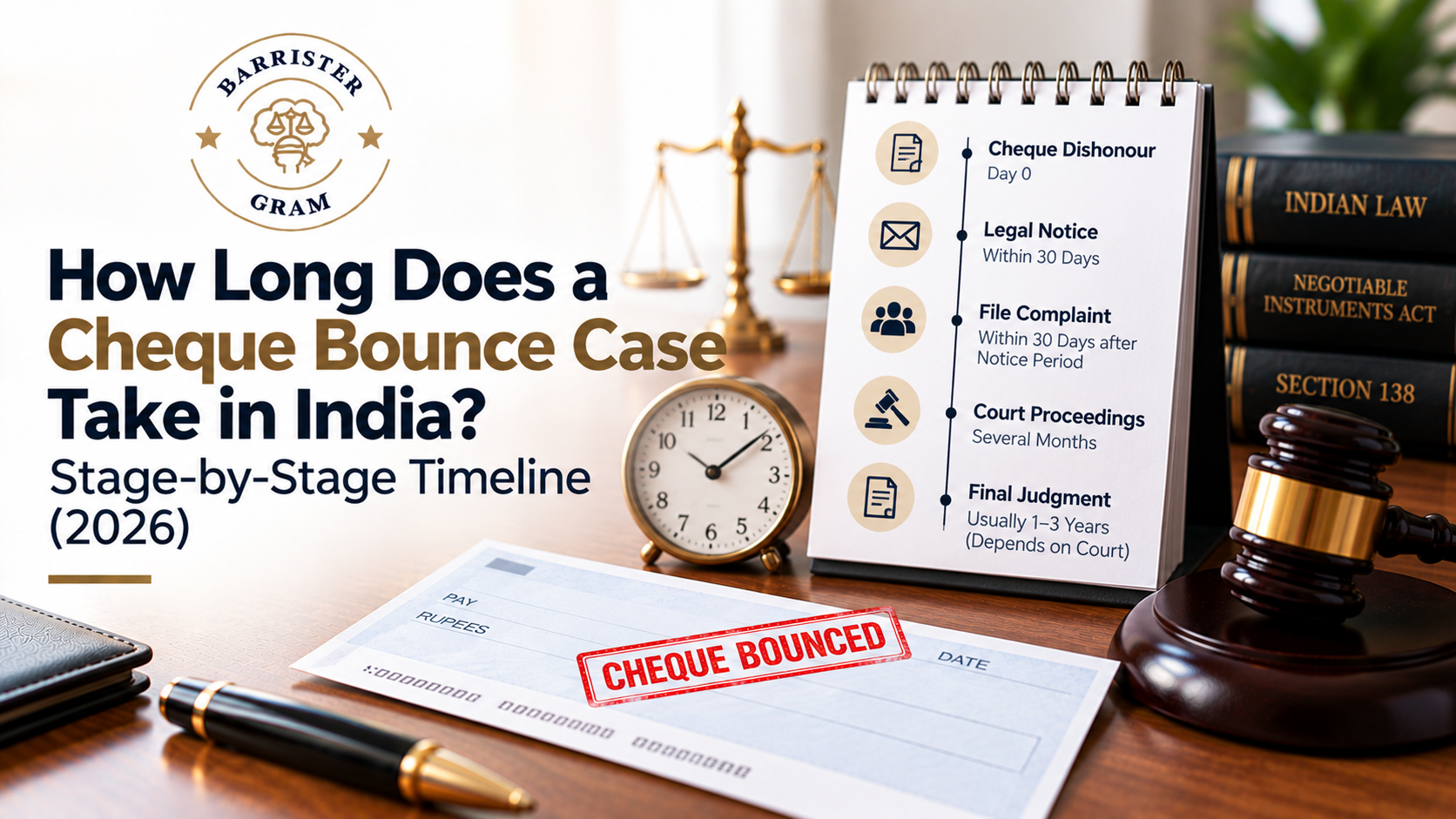
How Long Does a Cheque Bounce Case Take in India? Stage-by-Stage Timeline (2026)
Under Section 143(3), Negotiable Instruments Act, 1881, courts should try to finish a cheque bounce trial within 6 months of filing. In practice, a contested case often takes 1 to 3 years at the trial court, and appeals can add more time. Many cases end within a few months through settlement, especially after the Supreme Court’s 2025 guidelines.
Key Takeaways
- Section 143(3) of the Negotiable Instruments Act, 1881 directs that a cheque bounce trial should be concluded, as far as possible, within six months from the date of filing the complaint.
- The six-month target is directory, not mandatory, and contested cases commonly take one to three years at the trial court because of delays in serving summons and repeated adjournments.
- Before a case can even be filed, the legal process takes roughly two to three months: a 30-day notice period, a 15-day payment window and up to one month to file the complaint.
- In Sanjabij Tari v. Kishore S. Borcar (2025), the Supreme Court directed electronic service of summons, online payment facilities and early settlement to cut delays.
- A case can end at any stage through compounding under Section 147 of the NI Act, at no extra cost if payment is made before defence evidence is recorded.
- An appeal to the Sessions Court and a revision before the High Court can each add months or years to the overall timeline.
Introduction
“How long will it take?” is the question every payee and every accused asks after a cheque bounce case is filed. The law promises speed: cheque bounce cases are tried summarily, and the trial is supposed to finish in six months.
The reality in many courts is slower. Summons go unserved, the accused does not appear, adjournments pile up, and a simple case can stretch over years.
This guide breaks the timeline into stages, explains how long each stage usually takes and why, and sets out practical steps that complainants and accused persons can take to finish the case faster.
What Does the Law Say About the Time Limit for a Cheque Bounce Trial?
The law asks courts to finish the trial within six months of filing, using a summary procedure and day-to-day hearings as far as practicable.
What the law says
(a) The statute: Section 143(1) of the NI Act requires cheque bounce cases to be tried summarily. Section 143(2) says the trial shall, so far as practicable, continue from day to day until it concludes. Section 143(3) says the court should make “an endeavour” to conclude the trial within six months from the date of filing the complaint.
(b) What courts have held: In In Re: Expeditious Trial of Cases under Section 138 of the NI Act (2021), a Constitution Bench of the Supreme Court issued directions to speed up these trials, including on summary trial, evidence on affidavit and service of summons. In Sanjabij Tari v. Kishore S. Borcar (2025), the Court issued further nationwide directions, which courts were directed to implement by 1 November 2025.
(c) Practical advice: The six-month target is not a guarantee. Plan for the case to take longer if it is contested, and use the tools described below to push it forward.
The law at a glance
| Provision | How it affects the timeline |
| Section 138, NI Act | 30-day notice and 15-day payment period before the offence is complete |
| Section 142(1)(b), NI Act | Complaint within one month of the cause of action |
| Section 143, NI Act | Summary trial, day-to-day hearings, six-month target |
| Section 143A, NI Act | Interim compensation up to 20%, payable within 60 + 30 days |
| Section 144, NI Act | Summons can be served by speed post or approved courier |
| Section 145, NI Act | Complainant’s evidence on affidavit, saving time |
| Section 147, NI Act | Compounding at any stage ends the case |
| Section 148, NI Act | Deposit on appeal, which discourages delaying appeals |
Cheque Bounce Case Timeline: Stage by Stage
The full journey has three phases: the pre-filing period fixed by law, the trial, and any appeal. Only the first phase has firm deadlines.
| Stage | Legal time limit | Typical time in practice | Main reason for delay |
| Cheque bounces to legal notice | Within 30 days of return memo | 1 to 4 weeks | Collecting the memo, drafting |
| Notice to end of payment period | 15 days from receipt | 2 to 4 weeks, including postal delivery | Delivery delays |
| Filing the complaint | Within one month of cause of action | 1 to 4 weeks | Preparing documents |
| Cognizance and issue of summons | No fixed limit | 1 to 3 months | Court workload, scrutiny of complaint |
| Service of summons and first appearance | No fixed limit | 1 to 12 months or more | Accused not found, wrong address, evasion |
| Plea, interim compensation, settlement talks | No fixed limit | 1 to 3 months | Adjournments for settlement |
| Complainant’s evidence and cross-examination | No fixed limit | 2 to 6 months | Adjournments, advocate availability |
| Defence evidence | No fixed limit | 2 to 6 months | Adjournments |
| Final arguments and judgment | No fixed limit | 1 to 3 months | Court workload |
| Trial total | Target: 6 months | Often 1 to 3 years if contested | |
| Appeal to Sessions Court | Filed within limitation period | 6 months to 2 years | Appellate court workload |
| Revision in High Court | Filed within limitation period | 1 year or more | High Court pendency |
Note: The “typical time in practice” figures are general estimates based on common experience in Indian courts. They are not fixed by law and vary widely by court, state and the conduct of the parties.
Why Do Cheque Bounce Cases Take So Long?
Most delay comes from the stages the law does not time-limit: serving summons, securing the accused’s appearance, and adjournments.
The main causes
- Service of summons. The accused may have moved, may avoid service, or the address may be wrong. This is often the single longest delay.
- Non-appearance of the accused, leading to bailable and then non-bailable warrants.
- Adjournments sought by either side, often for settlement talks that do not succeed.
- Court workload. The Supreme Court has repeatedly noted the very large number of cheque bounce cases pending in trial courts.
- Conversion to a summons trial, if the Magistrate decides a longer sentence may be needed, which makes the procedure longer.
- Multiple cheques, each giving rise to a separate case, unless they are tried together.
- Transfer and jurisdiction disputes, especially when the accused lives in a different state.
What the Supreme Court has done about it
In Sanjabij Tari v. Kishore S. Borcar (2025), the Supreme Court directed:
- Service of summons by electronic means (email, WhatsApp, mobile) and dasti (hand delivery by the complainant), in addition to post
- A standard synopsis with each complaint, so the court can see the key facts at once
- Online and UPI payment facilities in district courts so the accused can pay the cheque amount directly
- No summons at the pre-cognizance stage under Section 223 BNSS
- Structured questioning at the first hearing to encourage early settlement
- Reduced compounding costs to make early settlement attractive
- Dashboards to monitor pending cheque bounce cases
How Long Does It Take If the Case Is Settled?
A settled case can end within weeks or a few months of the first hearing, which is why most cheque bounce cases do not run their full course.
Under Section 147 of the NI Act, the offence can be compounded at any stage. The Supreme Court’s 2025 graded costs encourage early settlement:
| Stage of settlement | Additional cost (% of cheque amount) | Typical time to closure |
| Before defence evidence | Nil | Within a few months of filing |
| After defence evidence, before judgment | 5% | Later in the trial |
| Appeal or revision before Sessions Court or High Court | 7.5% | During appeal |
| Before the Supreme Court | 10% | Final stage |
Lok Adalat: Many cheque bounce cases are settled in National Lok Adalats, which are held several times a year. A Lok Adalat settlement is final and ends the case on the same day.
Payment with costs: In Meters and Instruments Pvt. Ltd. v. Kanchan Mehta (2018), the Supreme Court held that a court may close proceedings if the accused pays the cheque amount with interest and costs, even without the complainant’s consent.
How to Speed Up a Cheque Bounce Case
Both sides can shorten the case by preparing well and using the tools the law and the Supreme Court have provided.
Tips for the complainant
- File complete documents with the complaint, including the synopsis, affidavit and proof of service, so no time is lost on objections.
- Give every address, email and mobile number of the accused in the complaint, so summons can be served electronically and by post.
- Take dasti summons and serve them yourself where the court allows it.
- Seek interim compensation under Section 143A at the earliest stage, which often prompts settlement.
- Ask for a single trial where several cheques from the same transaction are involved, as permitted by the Supreme Court’s 2021 directions.
- Avoid unnecessary adjournments and keep your witnesses ready.
- Consider a Lok Adalat referral if the accused is willing to pay.
Tips for the accused
- Appear on the first date to avoid warrants and the delay they cause.
- Decide early whether to settle or contest.
- Settle before defence evidence if the debt is genuine, to close the case at no extra cost.
- Pay interim compensation on time to avoid recovery proceedings.
- Keep your documents ready if you are contesting, so evidence can be completed quickly.
Worked Example: Two Timelines for the Same Cheque
This example compares a settled case with a contested one.
Ritu Desai, a landlord in Pune, receives a cheque for ₹1,80,000 towards rent arrears from her tenant, Manoj Kulkarni. The cheque is dated 1 February 2026 and bounces.
| Stage | Settled case | Contested case |
| Return memo received | 10 Feb 2026 | 10 Feb 2026 |
| Notice sent | 20 Feb 2026 | 20 Feb 2026 |
| Notice received by Manoj | 24 Feb 2026 | 24 Feb 2026 |
| Complaint filed | 20 Mar 2026 | 20 Mar 2026 |
| Summons served (by WhatsApp and post) | May 2026 | Manoj evades service; served Oct 2026 |
| First appearance and bail | Jun 2026 | Nov 2026 |
| Interim compensation ordered (20%) | Jun 2026 | Dec 2026 |
| Outcome | Manoj pays in full in Jul 2026; case compounded at no extra cost | Evidence and arguments through 2027; judgment expected in 2028 |
| Total from bounce | About 5 months | About 2 years or more |
The legal steps before filing took the same time in both cases. The difference came from service of summons and Manoj’s decision whether to settle.
Rights of Both Sides on Delay
The complainant
- Ask the court for day-to-day hearings under Section 143(2)
- Seek interim compensation under Section 143A
- Oppose repeated adjournments
- Approach the High Court in rare cases of extreme, unexplained delay
The accused
- A fair trial, including time to prepare a defence
- Bail, since the offence is bailable
- Settle at any stage to end the case
- Seek exemption from personal appearance when permitted
Costs Linked to a Longer Case
- Advocate’s fees increase with the number of hearings.
- Travel and time costs add up, especially if the case is in another city.
- Interim compensation of up to 20% is paid by the accused during trial.
- Compounding costs rise from nil to 5%, 7.5% and 10% as the case moves forward.
- Appeal deposits of at least 20% of the fine or compensation may be ordered under Section 148.
Common Mistakes That Delay a Cheque Bounce Case
- Incomplete complaint documents, leading to objections and refiling.
- Only one address for the accused, making service of summons difficult.
- Not using electronic service of summons.
- Repeated adjournments for settlement without any real progress.
- Accused skipping hearings, leading to warrants and further delay.
- Filing separate cases for each cheque without seeking a joint trial where permitted.
- Waiting for the full trial when an early settlement was possible.
Key Court Rulings on Speed and Delay
| Case | Court and year | Key holding (one line) |
| Damodar S. Prabhu v. Sayed Babalal H., (2010) 5 SCC 663 | Supreme Court, 2010 | Introduced graded compounding costs to encourage early settlement. |
| Meters and Instruments Pvt. Ltd. v. Kanchan Mehta, (2018) 1 SCC 560 | Supreme Court, 2018 | Courts may close proceedings if the accused pays with costs; the offence is primarily compensatory. |
| In Re: Expeditious Trial of Cases under Section 138 of the NI Act, (2021) 16 SCC 116 | Supreme Court, 2021 | Constitution Bench directions for faster trials, including on summary trial and joint trials. |
| Sanjabij Tari v. Kishore S. Borcar, 2025 INSC 1158 | Supreme Court, 2025 | Nationwide directions on electronic summons, online payment, synopsis format and reduced compounding costs. |
FAQs
1. How long does a cheque bounce case take in India?
The law asks courts to try to finish the trial within six months of filing under Section 143(3) of the NI Act. In practice, a contested case often takes one to three years at the trial court, and an appeal adds more time. Cases that settle early can end within a few months.
2. Is the six-month time limit for a cheque bounce trial mandatory?
No. Section 143(3) only requires the court to make an “endeavour” to finish within six months, so it is directory, not mandatory. A trial that takes longer is not invalid. However, the provision allows parties to press for day-to-day hearings and to oppose unnecessary adjournments.
3. Why do cheque bounce cases take so long?
Mainly because of delays in serving summons, the accused not appearing, repeated adjournments and heavy court workloads. The legal steps before filing take only two to three months. Most of the delay happens after filing, in stages the law does not time-limit.
4. How long does it take to get money back from a cheque bounce case?
It depends on whether the accused settles. Many accused pay within weeks or months of the first hearing, especially after interim compensation is ordered. If the case is contested, payment may come only after conviction, which can take one to three years, plus any time spent in appeal.
5. How long does the pre-filing process take after a cheque bounces?
Usually two to three months. You have 30 days from receiving the return memo to send the notice, the drawer has 15 days from receipt to pay, and you then have one month to file the complaint. Postal delivery time adds to this.
6. Can a cheque bounce case be finished quickly?
Yes, if both sides cooperate. Settling before defence evidence costs nothing extra under the Supreme Court’s 2025 guidelines, and Lok Adalats can close a case in a single sitting. Electronic service of summons and online payment facilities in district courts also help cases end faster.
7. How long does a cheque bounce appeal take?
Usually six months to two years in the Sessions Court, depending on the court’s workload, and longer if a revision is then filed in the High Court. The appellate court may require a deposit of at least 20% of the fine or compensation under Section 148 of the NI Act.
8. What happens if the accused does not appear in court?
The case is delayed. The court can issue a bailable warrant and then a non-bailable warrant, and may start proceedings to declare the accused a proclaimed person. The complainant should give all known addresses and contact details to help the court secure attendance.
9. Can several cheque bounce cases be tried together?
In some situations. The Supreme Court’s 2021 Constitution Bench directions allow cases arising from the same transaction to be tried together within the limits of the criminal procedure law. This can save considerable time where several cheques were issued for one deal. Each dishonoured cheque still gives rise to a separate offence.
10. Does interim compensation speed up a cheque bounce case?
Often, yes. When the court orders the accused to pay up to 20% of the cheque amount under Section 143A, the accused has a strong reason to settle rather than pay twice. The amount is refundable with interest if the accused is acquitted.
Conclusion
A cheque bounce case should take six months under the law, but contested cases often take one to three years in practice, while settled cases can end in a few months. The pre-filing steps take about two to three months; most delay happens later, in serving summons and adjournments. Complainants can speed things up with complete documents, electronic service and interim compensation; accused persons can save time and money by appearing promptly and settling early. For advice on your specific situation, consult a qualified advocate.


About Post Author


