


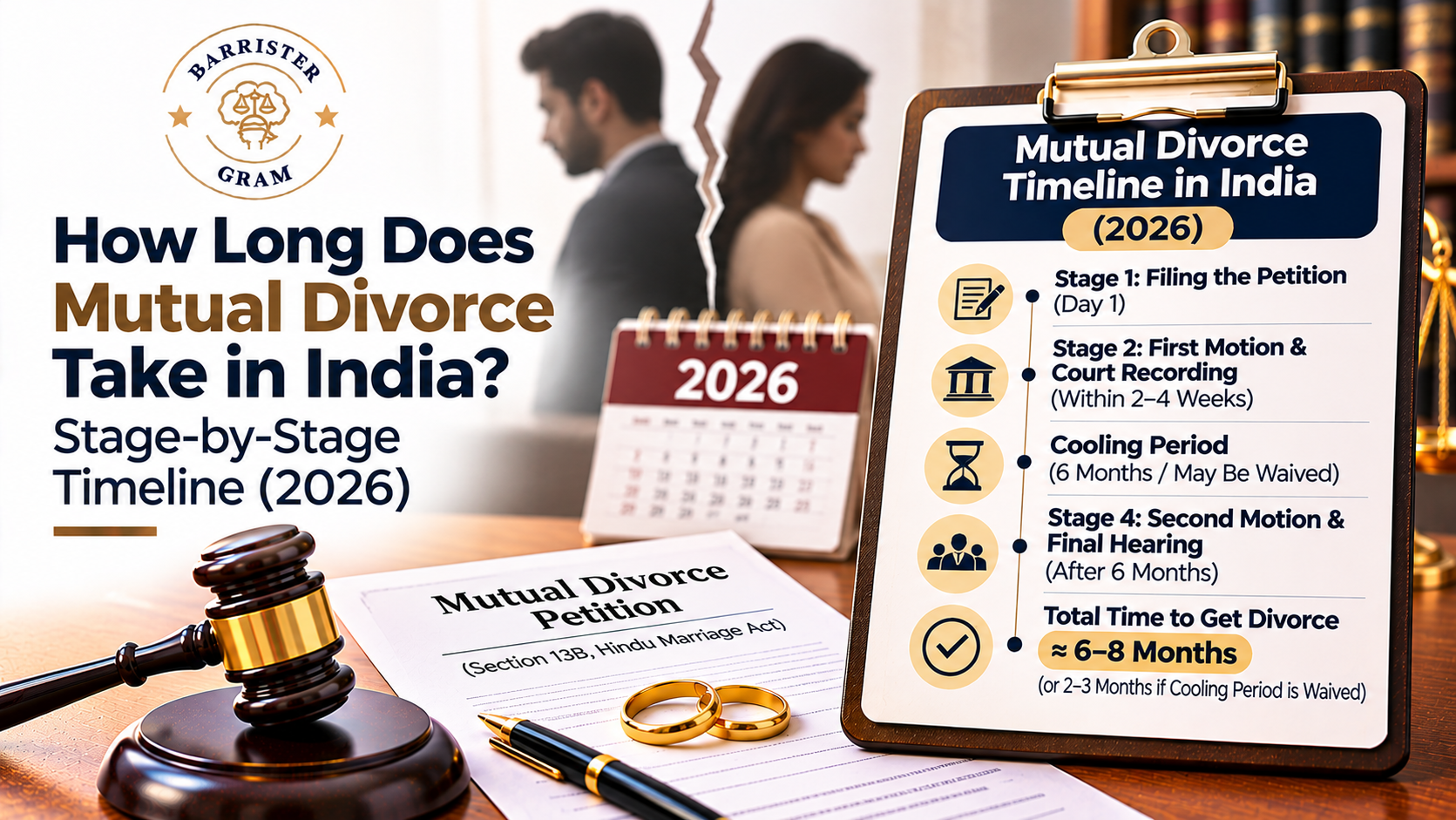
How Long Does Mutual Divorce Take in India? Stage-by-Stage Timeline (2026)
A mutual consent divorce under Section 13B, Hindu Marriage Act, 1955 usually takes about 6 to 18 months from filing, because the law requires a six-month gap between the first and second motions. If the court waives that period, the divorce can be granted in a few weeks to about three months. Before filing, the spouses must have lived separately for at least one year.
Key Takeaways
- A mutual consent divorce in India usually takes about six to eighteen months from filing the joint petition to the final decree.
- Before filing, both spouses must have lived separately for at least one year, under Section 13B(1) of the Hindu Marriage Act, 1955.
- The second motion can be heard no earlier than six months and no later than eighteen months after the petition is filed, under Section 13B(2).
- The six-month waiting period is directory, not mandatory, and Family Courts can waive it in suitable cases (Amardeep Singh v. Harveen Kaur, 2017; Misha Somani v. Rituraj Somani, 2026).
- When the waiting period is waived, a mutual divorce can often be completed within a few weeks to about three months of filing, depending on the court.
- Delays usually come from incomplete documents, unsettled terms on alimony or custody, mediation referrals and court workload, not from the law itself.
Introduction
“How long will our divorce take?” is usually the first question couples ask once they agree to separate. Mutual consent divorce is the fastest route available under Indian law, but it is not instant: the law builds in a waiting period, and courts follow a fixed sequence.
The good news is that the timeline is largely in the couple’s hands. With complete documents, a clear settlement and, where eligible, a request to waive the waiting period, many couples finish far sooner than the default timeline suggests.
This guide breaks the mutual divorce timeline into stages, explains how long each one usually takes, what causes delays, and how to finish faster.
What Does the Law Say About the Time for a Mutual Divorce?
The law sets two time rules: one year of separation before filing, and a six-to-eighteen-month window between filing and the second motion.
What the law says
(a) The statute:
- Section 13B(1), Hindu Marriage Act, 1955: A joint petition can be filed if the spouses have lived separately for one year or more, cannot live together, and have mutually agreed to dissolve the marriage.
- Section 13B(2): On a motion made “not earlier than six months after the date of the presentation of the petition” and “not later than eighteen months after the said date”, if the petition has not been withdrawn, the court passes a decree of divorce after hearing the parties and making such inquiry as it thinks fit.
(b) What courts have held:
- In Amardeep Singh v. Harveen Kaur (2017), the Supreme Court held that the six-month period is directory, not mandatory, and can be waived in suitable cases.
- In Misha Somani v. Rituraj Somani (decided 2 February 2026), the Supreme Court held that lower courts had wrongly treated the Amardeep Singh conditions as a rigid checklist, and granted the divorce without the waiting period.
- In Sureshta Devi v. Om Prakash (1991), the Court held that either spouse can withdraw consent before the decree.
(c) Practical advice: The six-month gap is the main time factor. If you have already been separated for a long time and have settled everything, ask your advocate about seeking a waiver at or soon after the first motion.
The law at a glance
| Law | Provision | Separation before filing | Waiting period after filing |
| Hindu Marriage Act, 1955 | Section 13B | 1 year | 6 months (waivable) |
| Special Marriage Act, 1954 | Section 28 | 1 year | 6 months |
| Divorce Act, 1869 (Christians) | Section 10A | 2 years | 6 months |
| Parsi Marriage and Divorce Act, 1936 | Section 32B | 1 year | 6 months |
Mutual Divorce Timeline: Stage by Stage
The full journey has three phases: separation before filing, the first motion, and the second motion leading to the decree.
| Stage | Legal time rule | Typical time in practice | Main reason for delay |
| Living separately before filing | At least 1 year | 1 year or more | Statutory requirement |
| Negotiating and signing the settlement | No fixed limit | 2 weeks to a few months | Alimony, custody and property terms |
| Preparing and filing the joint petition | No fixed limit | 1 to 3 weeks | Collecting documents |
| First motion hearing | No fixed limit | 1 to 6 weeks after filing | Court listing |
| Mediation or counselling, if referred | No fixed limit | 2 to 8 weeks | Number of sessions |
| Cooling-off period | 6 months from filing (waivable) | 6 months, or less if waived | Statutory requirement |
| Second motion | Between 6 and 18 months from filing | Shortly after 6 months, if filed promptly | Listing, attendance of both spouses |
| Decree of divorce | On the second motion | Same day to a few weeks | Court workload, typing and signing of decree |
| Certified copy of decree | No fixed limit | A few days to a few weeks | Copying section |
| Total from filing (no waiver) | About 6 to 18 months | ||
| Total from filing (with waiver) | Often a few weeks to about 3 months |
Note: The “typical time in practice” figures are general estimates based on common experience in Indian Family Courts. They are not fixed by law and vary widely by court and city.
Why Does a Mutual Divorce Sometimes Take Longer?
Most delays come from the couple’s own unresolved issues or incomplete paperwork, not from the law.
- Unsettled terms. Disagreements on alimony, child custody, visitation or property after filing are the single biggest cause of delay.
- Incomplete documents. Missing proof of marriage, residence or separation can lead to adjournments.
- Mediation referrals. Courts may refer the couple to mediation or counselling before recording the first motion.
- Non-appearance. Both spouses must usually appear; if one cannot attend, the hearing may be adjourned.
- Late second motion. Couples who do not file the second motion soon after six months extend the timeline themselves.
- Withdrawal of consent. If one spouse withdraws consent, the mutual divorce cannot proceed, and the couple may have to start a contested case.
- Court workload. Busy Family Courts may list cases weeks apart.
How Long Does Mutual Divorce Take If the Six-Month Period Is Waived?
With a waiver, the court can pass the decree soon after recording the first motion, often within a few weeks to about three months of filing.
In Amardeep Singh v. Harveen Kaur (2017), the Supreme Court identified the factors a court considers when deciding whether to waive the period:
- The one-year separation and the six-month waiting period have already passed, or will soon pass, counting from the separation.
- All efforts at mediation and reconciliation have failed.
- The parties have genuinely settled all their differences, including alimony and custody.
- The waiting period would only prolong their agony.
In Misha Somani v. Rituraj Somani (2026), the Supreme Court clarified that these factors are illustrative, not a rigid checklist, and that courts should waive the period where the circumstances justify it. The decision whether to waive still lies with the court on the facts of each case.
For a detailed guide to the waiver, see our separate article on whether the six-month cooling period can be waived in mutual divorce.
Worked Example: Two Timelines for the Same Couple
This example compares the default timeline with a waiver.
Rohan and Priya Mehta married in Pune in 2019. They have lived separately since 1 January 2025 and agreed all terms, including alimony and their daughter’s custody.
| Stage | Without waiver | With waiver |
| Joint petition filed | 1 Jul 2026 | 1 Jul 2026 |
| First motion recorded | 20 Jul 2026 | 20 Jul 2026 |
| Waiver application filed | Not filed | 20 Jul 2026 (separation already 18 months; mediation completed; all terms settled) |
| Second motion | Filed 5 Jan 2027 (after 6 months) | Court allows waiver and hears second motion on 10 Aug 2026 |
| Decree of divorce | Jan 2027 | Aug 2026 |
| Total from filing | About 6 to 7 months | About 6 weeks |
Both timelines assume both spouses attend every hearing and the settlement terms are complied with. The court’s decision on the waiver depends on its assessment of the facts.
How to Complete a Mutual Divorce Faster
Before filing
- Settle every term in writing: alimony, child custody and visitation, maintenance, stridhan, property and pending cases.
- Collect all documents: marriage proof, identity and address proof, proof of separation, income proof.
- File in the right Family Court under Section 19 of the Hindu Marriage Act.
During the case
- Attend the first motion together, or arrange video conferencing in advance if one spouse is abroad.
- Complete mediation sessions promptly if referred.
- Seek a waiver of the six-month period if you meet the conditions.
- File the second motion soon after six months if there is no waiver.
- Comply with settlement payments on time, as courts usually check compliance at the second motion.
After the decree
- Apply for a certified copy of the decree promptly.
- Update records such as passports, bank accounts and property documents.
Remarriage After a Mutual Divorce
Under Section 15 of the Hindu Marriage Act, a divorced person may remarry once the decree is final and the time for appeal has expired without an appeal, or an appeal has been dismissed. Appeals against mutual consent decrees are rare, but many advocates still advise waiting until the appeal period under Section 28(4) of the Hindu Marriage Act (90 days from the decree) has passed before remarrying. Take advice on your specific facts.
Costs Linked to the Timeline
- Advocate’s fees may rise with the number of hearings.
- Court fee on the petition is usually a small fixed amount, varying by state.
- Mediation at court-annexed centres is usually free.
- Alimony instalments are often linked to the first and second motions, so delays can also delay payments.
Common Mistakes That Delay a Mutual Divorce
- Filing before one year of separation.
- Leaving alimony or custody “to be decided later”.
- Giving different separation dates in the two affidavits.
- Missing the second motion window, which closes 18 months after filing.
- Not seeking a waiver when eligible.
- One spouse failing to appear without arranging video conferencing.
- Delaying settlement payments, leading the other spouse to hold back consent.
Key Court Rulings on the Mutual Divorce Timeline
| Case | Court and year | Key holding (one line) |
| Sureshta Devi v. Om Prakash, (1991) 2 SCC 25 | Supreme Court, 1991 | Either spouse can withdraw consent before the decree. |
| Amardeep Singh v. Harveen Kaur, (2017) 8 SCC 746 | Supreme Court, 2017 | The six-month period is directory and can be waived in suitable cases. |
| Amit Kumar v. Suman Beniwal, 2021 | Supreme Court, 2021 | Reiterated that the waiting period is not mandatory and can be waived. |
| Shilpa Sailesh v. Varun Sreenivasan, 2023 | Supreme Court (Constitution Bench), 2023 | The Supreme Court can grant divorce under Article 142 without the waiting period in appropriate cases. |
| Misha Somani v. Rituraj Somani, Civil Appeal No. 801 of 2026 | Supreme Court, 2 Feb 2026 | The Amardeep Singh factors are not a rigid checklist; waiver should be granted where justified. |
FAQs
1. How long does a mutual divorce take in India?
Usually about six to eighteen months from filing the joint petition, because Section 13B(2) of the Hindu Marriage Act requires the second motion to be made at least six months after filing. If the court waives the six-month period, a mutual divorce can often be completed within a few weeks to about three months.
2. What is the minimum time for a mutual divorce?
With a waiver of the six-month period, the court can pass the decree soon after recording the first motion, which can be within a few weeks of filing. Before filing, however, the spouses must have lived separately for at least one year. The exact time depends on the court and the facts.
3. Can a mutual divorce be done in one month?
Sometimes. If the court waives the six-month cooling period and both spouses attend promptly with all terms settled and complied with, some courts grant the decree within a month or so of filing. This depends entirely on the court’s assessment and its listing schedule.
4. Why is there a six-month waiting period in mutual divorce?
The six-month period under Section 13B(2) gives the couple time to reconsider and possibly reconcile. The Supreme Court held in Amardeep Singh v. Harveen Kaur (2017) that it is directory, not mandatory, so courts can waive it where reconciliation is impossible and all issues are settled.
5. What is the maximum time to file the second motion?
Eighteen months from the date the joint petition was filed. Under Section 13B(2), the second motion must be made not earlier than six months and not later than eighteen months after the petition is presented. If it is not made in time, the petition may lapse.
6. Do we have to live separately for one year before filing?
Yes. Section 13B(1) requires the spouses to have lived separately for one year or more before filing. “Living separately” means not living as husband and wife, and both affidavits should state the same date of separation.
7. How long does it take to get the divorce decree after the second motion?
Often the same day or within a few weeks, depending on the court. After the decree is passed, applying for a certified copy may take a few more days or weeks, depending on the court’s copying section.
8. When can I remarry after a mutual divorce?
Under Section 15 of the Hindu Marriage Act, once the decree is final and the time for appeal has passed or an appeal has been dismissed. Appeals against mutual consent decrees are rare, but many advocates advise waiting until the 90-day appeal period under Section 28(4) has passed.
9. Can a mutual divorce be delayed by one spouse?
Yes. Either spouse can withdraw consent at any time before the decree, as held in Sureshta Devi v. Om Prakash (1991). A spouse can also delay matters by not attending hearings. If consent is withdrawn, the couple may need to pursue a contested divorce instead.
10. Does a Special Marriage Act divorce take the same time?
Broadly yes. A mutual divorce under Section 28 of the Special Marriage Act, 1954 also requires one year of separation before filing and a second motion between six and eighteen months after filing. Courts have applied similar reasoning on waiving the waiting period.
Conclusion
A mutual divorce in India usually takes six to eighteen months from filing, but couples who have already lived apart for a long time and settled every issue can often finish much sooner by asking the court to waive the six-month period. Settle all terms in writing before filing, keep your documents complete, attend every hearing, and file the second motion promptly. For advice on your specific situation, consult a qualified advocate.


About Post Author


