


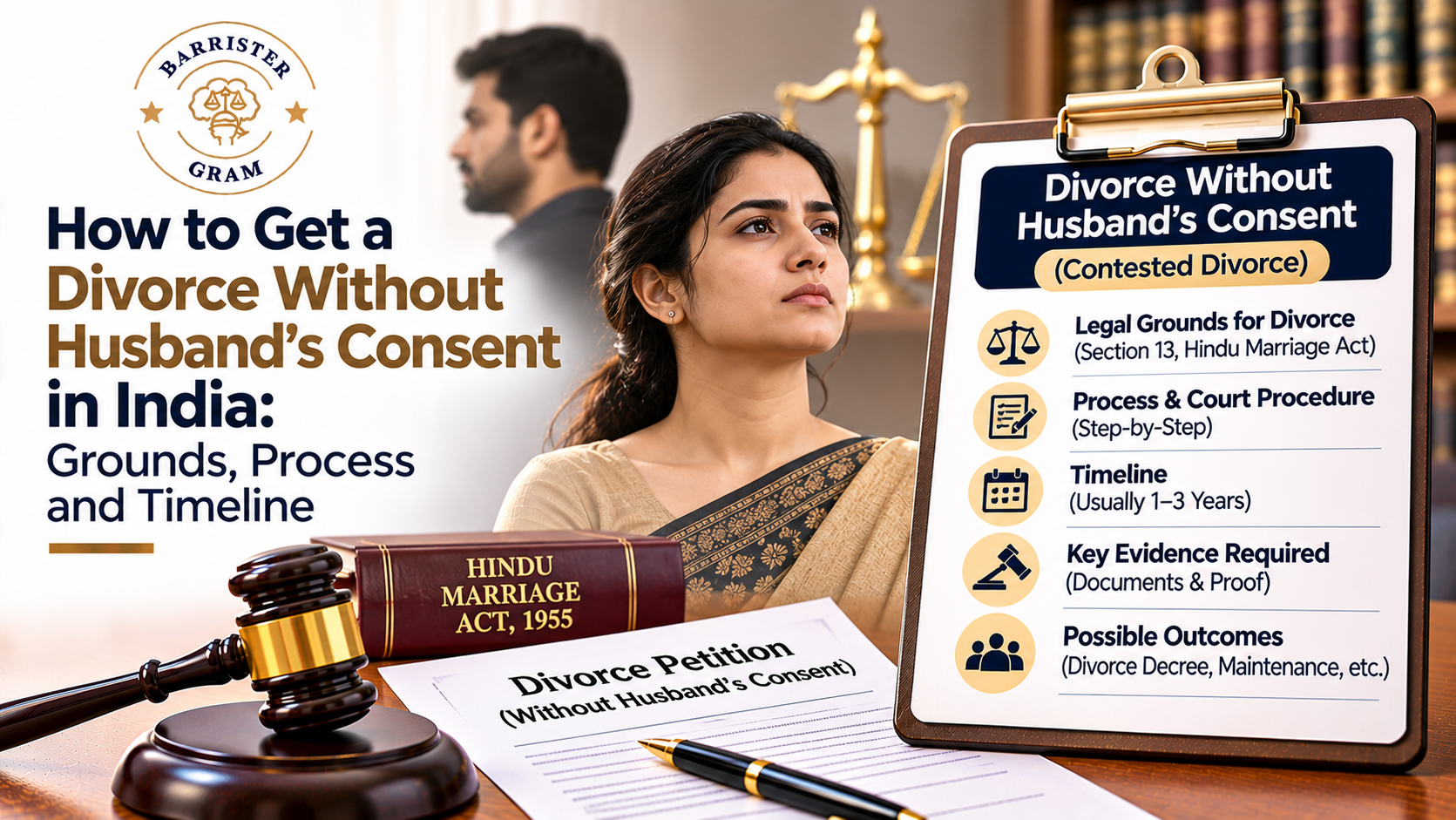
How to Get a Divorce Without Husband’s Consent in India: Grounds, Process and Timeline
Yes, a wife can get a divorce in India without her husband’s consent by filing a contested divorce petition under Section 13, Hindu Marriage Act, 1955 (or the law that applies to her marriage). She must prove a legal ground, such as cruelty, desertion for two years, adultery or mental disorder. If the husband does not appear after notice, the court can proceed ex parte. A contested divorce usually takes two to five years.
Key Takeaways
- A wife does not need her husband’s consent to get a divorce in India; she can file a contested divorce petition and prove a ground recognised by law.
- Under Section 13(1) of the Hindu Marriage Act, 1955, the main grounds are cruelty, adultery, desertion for at least two years, conversion, incurable mental disorder, communicable venereal disease, renunciation of the world and not being heard of for seven years.
- Section 13(2) gives a wife additional grounds, including the husband’s rape, sodomy or bestiality, and non-resumption of cohabitation for one year after a maintenance order in her favour.
- Under Section 19 of the Hindu Marriage Act, a wife can file the petition in the Family Court where she currently lives.
- If the husband does not appear despite being served, the court can hear the case ex parte and grant a decree on the wife’s evidence.
- While the case is pending, the wife can seek interim maintenance and litigation expenses under Section 24 of the Hindu Marriage Act and other laws.
Introduction
Many women stay in unhappy or abusive marriages because they believe a divorce is impossible if the husband refuses to agree. That is a common misconception. Indian law allows either spouse to seek divorce on legal grounds, whether or not the other spouse consents.
A divorce without consent, called a contested divorce, takes longer and needs evidence. But with the right ground, proper documents and a well-prepared case, it is fully achievable, and the law gives women specific protections, including the right to file where they live and to claim maintenance while the case continues.
This guide explains the legal grounds, the step-by-step process, the evidence needed, how long it takes, what happens if the husband does not appear, and the wife’s rights to maintenance and custody along the way.
Can a Wife Get a Divorce Without Her Husband’s Consent?
Yes. A wife can file a contested divorce petition and obtain a decree by proving one of the grounds set out in the law that governs her marriage. The husband’s consent is not required.
What the law says
(a) The statute: Section 13(1) of the Hindu Marriage Act, 1955 allows “either the husband or the wife” to petition for divorce on specified grounds. Section 13(2) gives the wife further grounds. Mutual consent under Section 13B is only one route; Section 13 does not require the other spouse’s agreement.
(b) What courts have held: In Samar Ghosh v. Jaya Ghosh (2007), the Supreme Court gave detailed illustrations of mental cruelty, which is the most commonly used ground. In Shilpa Sailesh v. Varun Sreenivasan (2023), a Constitution Bench held that the Supreme Court can dissolve a marriage that has irretrievably broken down under Article 142 of the Constitution, even without the other spouse’s consent, though irretrievable breakdown is not itself a ground available in Family Courts.
(c) Practical advice: Before filing, identify the ground you can best prove with documents and witnesses. Cruelty and desertion are the most common grounds used by wives.
Which law applies to you
| Marriage | Law | Divorce provision |
| Hindus, Buddhists, Jains, Sikhs | Hindu Marriage Act, 1955 | Section 13 |
| Inter-faith or civil marriage | Special Marriage Act, 1954 | Section 27 |
| Christians | Divorce Act, 1869 | Section 10 |
| Parsis | Parsi Marriage and Divorce Act, 1936 | Section 32 |
| Muslims | Dissolution of Muslim Marriages Act, 1939; Muslim personal law (khula) | Section 2 of the 1939 Act |
Grounds for Divorce Without Husband’s Consent
The wife must prove at least one recognised ground. The table below covers the Hindu Marriage Act; other laws have similar grounds.
| Ground | Provision | What must be shown |
| Cruelty | Section 13(1)(ia) | Physical or mental cruelty making it unreasonable to live together |
| Adultery | Section 13(1)(i) | Voluntary sexual intercourse with another person after marriage |
| Desertion | Section 13(1)(ib) | Desertion without reasonable cause for at least two years before filing |
| Conversion | Section 13(1)(ii) | Husband ceased to be a Hindu by converting to another religion |
| Mental disorder | Section 13(1)(iii) | Incurable unsoundness of mind or mental disorder making cohabitation unreasonable |
| Venereal disease | Section 13(1)(v) | Communicable venereal disease |
| Renunciation | Section 13(1)(vi) | Renounced the world by entering a religious order |
| Presumed death | Section 13(1)(vii) | Not heard of as alive for seven years or more |
| Non-resumption after decree | Section 13(1A) | No cohabitation for one year or more after a decree of judicial separation or restitution of conjugal rights |
| Husband’s bigamy (pre-1955 marriages) | Section 13(2)(i) | Husband had another living wife from before the Act |
| Rape, sodomy or bestiality | Section 13(2)(ii) | Husband guilty of these acts |
| Maintenance order and no cohabitation | Section 13(2)(iii) | Maintenance awarded to the wife, and no cohabitation for one year or more since |
| Repudiation of child marriage | Section 13(2)(iv) | Married before 15 and repudiated the marriage after 15 but before 18 |
Cruelty: the most common ground
Cruelty can be physical or mental. Courts have recognised, among other things:
- Physical violence or threats
- Persistent abuse, humiliation or false accusations
- Dowry demands and harassment
- Refusal of marital relations without reason for a long period
- Filing false criminal cases
- Unilateral refusal to have children, or other conduct causing deep mental suffering
In Samar Ghosh v. Jaya Ghosh (2007), the Supreme Court said mental cruelty must be judged on the whole of the married life and the circumstances of the parties. In V. Bhagat v. D. Bhagat (1994), it held that mental cruelty is conduct that makes it impossible for the spouse to live with the other.
Desertion
Desertion means leaving the spouse permanently, without reasonable cause and without consent, with the intention of ending cohabitation. It must have continued for at least two years before filing. In Bipin Chander Jaisinghbhai Shah v. Prabhawati (1957), the Supreme Court explained that both the fact of separation and the intention to end cohabitation must be proved.
Step-by-Step Process for a Contested Divorce
The wife files a petition, the husband is served, the court tries mediation, evidence is recorded, and the court decides.
- Consult an advocate and choose the ground or grounds you can prove.
- Collect evidence: medical records, police complaints, messages, emails, photographs, witnesses and financial documents.
- Draft the divorce petition stating the facts, the grounds and the reliefs sought, such as divorce, maintenance, custody and return of stridhan.
- File in the Family Court with jurisdiction. Under Section 19 of the Hindu Marriage Act, the wife can file where she resides, where the marriage was solemnised, where the husband resides, or where they last lived together.
- Court issues summons to the husband.
- Husband files a written statement, or the court proceeds ex parte if he does not appear despite service.
- Mediation and counselling: Family Courts usually refer the parties to mediation first.
- Interim applications: the wife can apply for interim maintenance and litigation expenses under Section 24, and for interim custody.
- Evidence: the wife and her witnesses give evidence, usually by affidavit, and are cross-examined; the husband then leads his evidence.
- Final arguments and judgment: the court passes a decree of divorce if the ground is proved.
- Appeal: either party may appeal within 90 days under Section 28 of the Hindu Marriage Act.
What If the Husband Does Not Appear or Avoids Notice?
The court can proceed ex parte and grant a divorce on the wife’s evidence if the husband has been properly served but does not appear.
- The court first ensures proper service of summons, by post, hand delivery, email or, if needed, substituted service such as newspaper publication.
- If the husband still does not appear, the court can set him ex parte and record the wife’s evidence.
- The wife must still prove the ground with evidence; an ex parte decree is not automatic.
- An ex parte decree can later be challenged by the husband if he shows he was not properly served, so careful service is important.
How Long Does a Divorce Without Consent Take?
A contested divorce usually takes two to five years, depending on the court, the evidence and whether the husband contests.
| Stage | Typical time |
| Filing and service of summons | 1 to 6 months |
| Mediation and counselling | 1 to 4 months |
| Written statement and interim applications | 2 to 6 months |
| Evidence of both sides | 1 to 3 years |
| Arguments and judgment | 3 to 9 months |
| Total (contested) | Often 2 to 5 years |
| Total (ex parte, if husband does not appear) | Often 6 months to 1.5 years |
These are general estimates from common experience in Indian Family Courts, not limits fixed by law.
Wife’s Rights During a Contested Divorce
A wife does not have to wait for the divorce to get financial support or protection.
| Right | Law | What it gives |
| Interim maintenance and litigation expenses | Section 24, Hindu Marriage Act | Monthly support and legal costs while the case is pending |
| Permanent alimony | Section 25, Hindu Marriage Act | Lump sum or periodic payment at the time of decree |
| Maintenance | Section 144, BNSS (earlier Section 125, CrPC) | Monthly maintenance for wife and children |
| Protection and residence | Protection of Women from Domestic Violence Act, 2005 | Protection orders, residence rights, monetary relief |
| Return of stridhan | Hindu law; Domestic Violence Act | Jewellery, gifts and personal property |
| Child custody | Section 26, Hindu Marriage Act; Guardians and Wards Act, 1890 | Interim and permanent custody, decided on the child’s welfare |
| Complaint for cruelty | Section 85, BNS (earlier Section 498A, IPC) | Criminal remedy for cruelty by husband or relatives |
In Rajnesh v. Neha (2020), the Supreme Court required both parties in maintenance cases to file affidavits disclosing their assets and liabilities, to make maintenance decisions faster and fairer.
Documents and Evidence Needed
- Marriage certificate, wedding photographs or invitation card
- Identity and address proof of the wife
- Proof of the ground: medical records, police complaints, FIRs, messages, emails, call recordings, photographs, witness statements
- Proof of separate residence and the date of separation (for desertion)
- Income proof of both spouses, if known, and affidavit of assets and liabilities
- Children’s birth certificates and school records
- List of stridhan and gifts
- Certificate under Section 63 of the Bharatiya Sakshya Adhiniyam, 2023 for electronic evidence
Worked Example: Divorce on the Ground of Cruelty
This example shows how a contested case can proceed.
Kavya married Rahul in 2020 in Indore. After repeated verbal abuse, dowry demands and one incident of violence in 2023, she moved back to her parents’ home in Bhopal. Rahul refuses to agree to a divorce.
| Date | Event | Relevance |
| Mar 2023 | Kavya leaves the matrimonial home; files a police complaint | Evidence of cruelty |
| Jan 2025 | Kavya files a divorce petition in the Family Court, Bhopal, on the ground of cruelty | Section 19 allows filing where she resides |
| Mar 2025 | Rahul served; files a written statement denying cruelty | Contested case |
| Apr to Jun 2025 | Mediation fails | Case proceeds |
| Jul 2025 | Court grants interim maintenance under Section 24 | Financial support during the case |
| 2025 to 2026 | Kavya’s evidence: medical records, police complaint, WhatsApp messages, her parents as witnesses; Rahul cross-examines | Proof of cruelty |
| Expected 2027 | Judgment | Divorce if cruelty is proved |
The outcome depends on how the evidence is assessed; the court decides whether the conduct amounts to cruelty in law.
Common Mistakes When Seeking Divorce Without Consent
- Filing without evidence of the chosen ground.
- Choosing desertion before two years have passed.
- Not claiming interim maintenance while the case is pending.
- Ignoring mediation, which can lead to a faster mutual settlement.
- Improper service on the husband, which can make an ex parte decree vulnerable.
- Exaggerated or false allegations, which can themselves be treated as cruelty.
- Not preserving electronic evidence properly with a Section 63 BSA certificate.
Key Court Rulings
| Case | Court and year | Key holding (one line) |
| Bipin Chander Jaisinghbhai Shah v. Prabhawati, AIR 1957 SC 176 | Supreme Court, 1957 | Desertion needs both separation and intention to end cohabitation. |
| V. Bhagat v. D. Bhagat, (1994) 1 SCC 337 | Supreme Court, 1994 | Mental cruelty is conduct making it impossible to live together. |
| Naveen Kohli v. Neelu Kohli, (2006) 4 SCC 558 | Supreme Court, 2006 | Recognised prolonged bitter litigation and separation as relevant to cruelty and breakdown. |
| Samar Ghosh v. Jaya Ghosh, (2007) 4 SCC 511 | Supreme Court, 2007 | Gave illustrations of mental cruelty, judged on the whole married life. |
| Rajnesh v. Neha, (2021) 2 SCC 324 | Supreme Court, 2020 | Mandatory disclosure of assets and liabilities in maintenance cases. |
| Shilpa Sailesh v. Varun Sreenivasan, 2023 | Supreme Court (Constitution Bench), 2023 | Supreme Court can dissolve an irretrievably broken marriage under Article 142. |
FAQs
1. Can a wife get a divorce without her husband’s consent in India?
Yes. A wife can file a contested divorce petition under Section 13 of the Hindu Marriage Act, 1955, or the law that applies to her marriage, and obtain a decree by proving a legal ground such as cruelty, desertion or adultery. The husband’s consent is not required.
2. What are the grounds for divorce without consent?
Under Section 13(1) of the Hindu Marriage Act, the grounds include cruelty, adultery, desertion for two years, conversion, incurable mental disorder, communicable venereal disease, renunciation and not being heard of for seven years. Section 13(2) gives wives additional grounds, such as the husband’s rape or sodomy and non-cohabitation after a maintenance order.
3. What if my husband refuses to appear in court?
If he has been properly served and still does not appear, the Family Court can proceed ex parte and decide the case on your evidence. You still need to prove the ground. Proper service, including substituted service by newspaper publication if needed, is important to protect the decree.
4. How long does a divorce without consent take?
Usually two to five years if the husband contests, because both sides lead evidence. If the husband does not appear and the case proceeds ex parte, it can often be completed within six months to about one and a half years. Timelines vary widely by court.
5. Where can a wife file for divorce?
Under Section 19 of the Hindu Marriage Act, in the Family Court where she currently resides, where the marriage was solemnised, where the husband resides, or where they last lived together. The right to file where the wife resides was added specifically to make it easier for women.
6. Can I get maintenance while the divorce case is pending?
Yes. You can apply for interim maintenance and litigation expenses under Section 24 of the Hindu Marriage Act, and for maintenance under Section 144 BNSS (earlier Section 125 CrPC). Both parties must disclose their assets and liabilities by affidavit, following Rajnesh v. Neha (2020).
7. Is irretrievable breakdown of marriage a ground for divorce?
Not in Family Courts, as it is not listed in the Hindu Marriage Act. However, the Supreme Court can dissolve a marriage that has irretrievably broken down under Article 142 of the Constitution, as confirmed by a Constitution Bench in Shilpa Sailesh v. Varun Sreenivasan (2023).
8. Can I file for divorce on the ground of desertion?
Yes, if your husband has deserted you without reasonable cause and without your consent for a continuous period of at least two years immediately before you file. You must prove both the separation and his intention to end the marriage.
9. What evidence is needed to prove cruelty?
Useful evidence includes medical records, police complaints, messages and emails, call recordings, photographs and witness statements from family, friends or neighbours. Courts judge cruelty on the whole of the married life, so a consistent account backed by documents is important.
10. Can a Muslim woman get a divorce without her husband’s consent?
Yes. A Muslim woman can seek a court decree on the grounds listed in Section 2 of the Dissolution of Muslim Marriages Act, 1939, such as cruelty, failure to maintain for two years or desertion for four years. She may also seek khula under Muslim personal law, and courts have recognised a wife’s right to khula.
Conclusion
A wife in India can end her marriage without her husband’s consent by filing a contested divorce petition and proving a legal ground such as cruelty, desertion or adultery. She can file where she lives, claim interim maintenance while the case is pending, and obtain a decree even if the husband does not appear, provided he is properly served. Build your case on evidence, use mediation where it may help, and plan for a process that can take a few years. For advice on your specific situation, consult a qualified advocate.


About Post Author


